
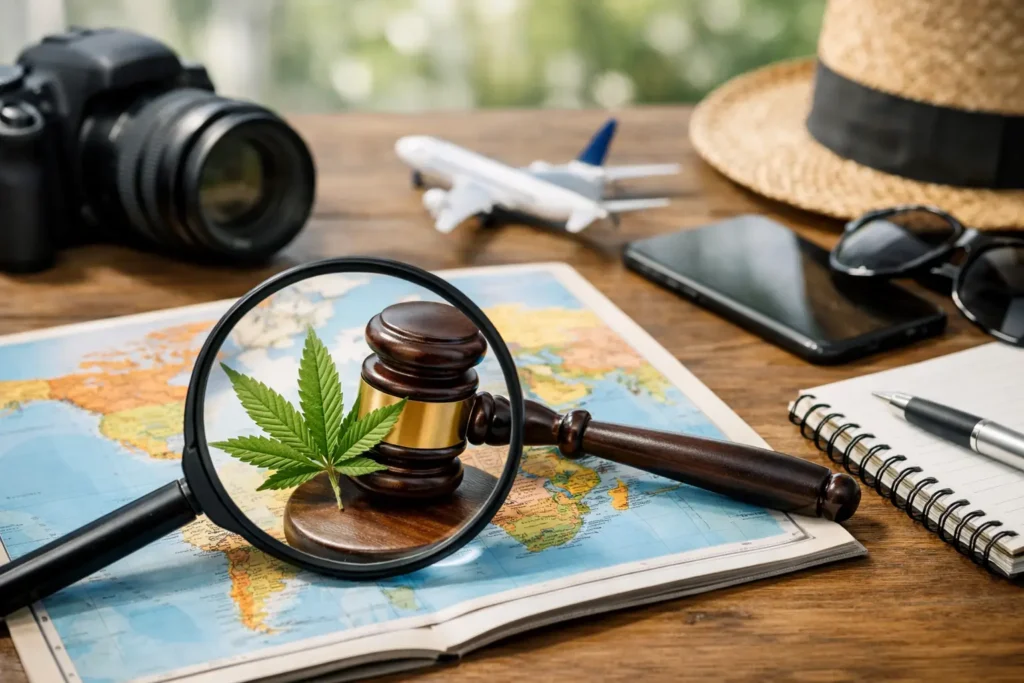
A destination can look cannabis-friendly on social media and still have rules that can ruin a vacation fast. Knowing how to research cannabis laws means looking beyond a headline that says “legal” and checking what that word actually means where you are going. Possession, public use, medical access, home cultivation, and tourist access can all be treated very differently in the same country.
Cannabis travel can be a great way to experience local culture, but it works best when you arrive informed. A little research before you pack helps you avoid legal weed hiccups, respect the people who live there, and focus on the trip instead of worrying about the rules.
Start With the Legal Status, Then Read the Fine Print
Your first question is simple: Is cannabis illegal, decriminalized, medical-only, tolerated, or legal for adult use? That answer gives you a starting point, not permission to assume anything else.
“Decriminalized” is one of the most misunderstood terms in weed travel. It often means that possession of a small amount may lead to a warning, fine, or civil penalty rather than criminal charges. It does not necessarily mean cannabis is legal to buy, carry freely, smoke in public, or bring into the country. In some destinations, police enforcement may be inconsistent, but that is not the same as a legal right.
Likewise, adult-use legalization may only apply to residents. A country or state can permit adults to possess cannabis while limiting purchases to people with local identification, registered members, or medical patients. Amsterdam is a classic example of why travelers need nuance: the city’s coffee shop culture is famous, but national law, local enforcement, and shop rules do not fit neatly into a single “weed is legal” label.
When you check a destination, separate the law into practical questions: what adults may possess, where use is allowed, whether visitors can legally access cannabis, and what penalties apply when the rules are broken.
How to Research Cannabis Laws Using Reliable Sources
Start with official information whenever possible. Government websites, health ministry notices, customs agencies, tourism authorities, and local municipal pages are usually the best place to confirm the legal baseline. They may not explain cannabis culture in friendly travel language, but they are far more useful than a viral video when you need to know whether a product can cross a border.
Then compare that information with current, destination-specific travel reporting. Local news outlets can reveal recent policy changes, enforcement campaigns, licensing delays, or city restrictions that national summaries miss. A cannabis law may have changed on paper, while stores have not opened yet. Or a city may have created special rules for public consumption, festivals, beaches, parks, or tourist districts.
Use a layered approach rather than trusting one source:
- Official government and customs guidance establishes what the law says.
- Local government notices clarify city, county, state, or provincial rules.
- Reputable local news shows whether a recent change is actually being enforced.
- Current destination guides help explain everyday etiquette and traveler realities.
Check publication dates closely. Cannabis policy moves quickly, particularly in places that are rolling out a new medical program, decriminalization policy, or regulated market. An article from two years ago may be accurate history and terrible travel advice.
Check Every Level of Government
One of the biggest mistakes travelers make is researching only the country. Cannabis rules can change at national, state or provincial, and city levels. Federal law may prohibit cannabis while a state allows adult use. A national government may allow possession, while individual municipalities prohibit smoking in public spaces. A city may tolerate certain businesses even though the wider legal framework remains complicated.
The United States is the most familiar example for many travelers. Cannabis can be legal under state law in a place like Nevada, California, or Massachusetts, but it remains illegal under federal law. That matters at airports, on federal land, and when crossing state lines. Flying from one legal state to another with cannabis is still a bad idea because you are entering a federally regulated travel system.
International travel has an even clearer rule: do not cross a border with cannabis, cannabis-infused products, vape cartridges, seeds, or CBD products unless you have verified that the specific item is permitted by both countries and by the carrier. In practice, the safest move is to travel without it. “Legal where I bought it” is not a defense at customs.
Also look at the exact city where you will sleep and spend your time. A beach town, island, historic district, ski resort, or major capital can have its own rules around smoking, odors, public nuisance, hotel balconies, and designated consumption areas. The destination name on your flight reservation is not enough research.
Separate Access From Legality
A place can have relaxed cannabis laws and still offer no legal way for a visitor to obtain cannabis. This is where travel planning gets more interesting than a simple legal map.
Ask whether regulated stores exist, whether they are open to tourists, and whether a medical card from home is recognized. Some medical programs accept only local patients. Some membership-based models require registration, advance paperwork, or an invitation from an existing member. Other destinations allow possession but have no legal retail market at all.
Never treat informal access as proof that something is lawful or safe. Street purchases bring obvious legal and quality risks, and they can put travelers in uncomfortable situations far from home. If the legal route is unclear, inaccessible, or limited to residents, treat that as a sign to skip it rather than improvise.
The same thinking applies to consumption. Hotels often prohibit smoking and vaping even where cannabis is legal. Rental properties may charge cleaning fees or remove guests for violating house rules. Public use may be restricted near schools, transit stations, restaurants, beaches, parks, and tourist landmarks. Cannabis-friendly does not mean every sidewalk, balcony, or hotel room is fair game.
Look for Rules That Affect Tourists Most
The details that catch travelers out are usually not the headline law. They are the rules around transportation, age, driving, packaging, and public behavior.
Confirm the minimum legal age. It may be 18, 19, 21, or another threshold depending on the destination and product type. Check possession limits and understand whether those limits apply per person, per day, or per household. If edibles are legal, look for limits on THC content, not just the weight of the package.
Driving deserves extra caution. Cannabis impairment laws vary, but driving while high is a risk everywhere. Some places use strict blood-level limits, roadside testing, or zero-tolerance rules for newer drivers. Keep cannabis out of the driver’s reach, do not consume in a vehicle, and use a taxi, rideshare, public transit, or a trusted sober driver if you choose to partake.
Finally, research local etiquette. In some places cannabis culture is visible but discreet. In others, it is private, social, medical, or still highly stigmatized despite changing laws. Being respectful means avoiding smoke around families and crowded public spaces, asking before using on private property, and not assuming locals want to discuss cannabis just because you are on vacation.
Make a Quick Cannabis Law Check Before Departure
The day before you leave, spend ten minutes confirming that nothing has changed. Search for recent government announcements, local enforcement updates, and transportation restrictions. If your trip includes more than one stop, repeat the check for each destination. A road trip can cross several legal systems in one afternoon.
Save the key information offline, especially if you will be relying on spotty hotel Wi-Fi or international data. Keep the notes practical: legal status, age limit, possession limit, tourist access, permitted consumption locations, and border or airport restrictions. Local Weed Guide-style destination research is most useful when it answers those real travel questions instead of offering a vague green-light or red-light label.
Pack your bags with curiosity, not assumptions. The best cannabis travelers are the ones who respect the destination, understand the rules on the ground, and leave with great memories instead of a problem that follows them home.