
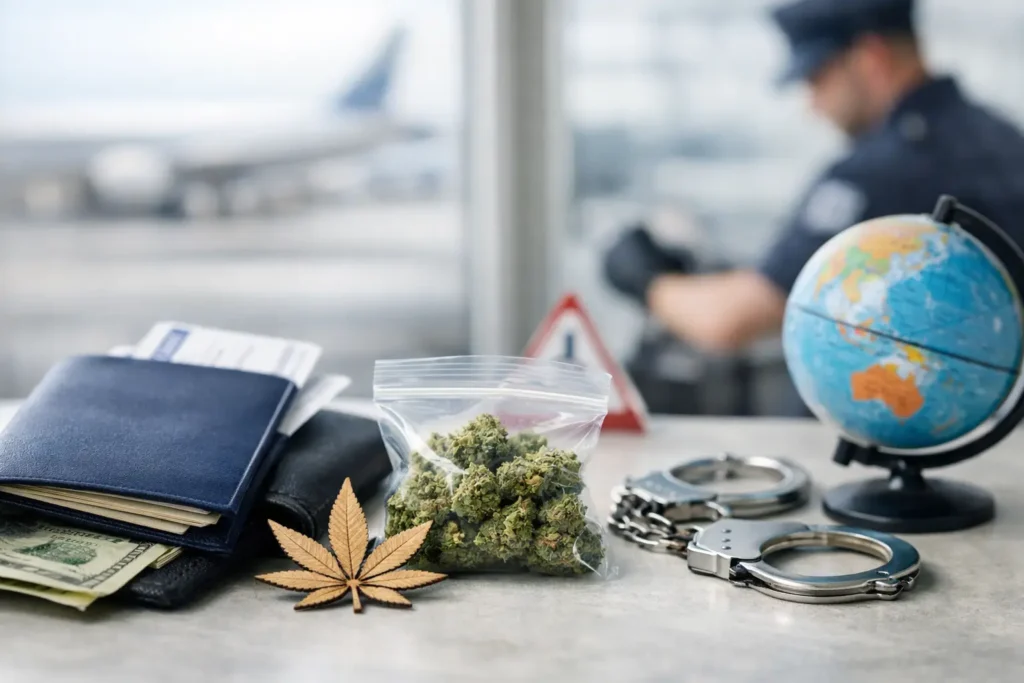
A jar that was legally purchased at home can become a serious problem the moment your flight crosses a border. That is the hard reality behind international cannabis restrictions: laws do not travel with you, even when your destination has a relaxed reputation, dispensaries, cannabis clubs, or visible local weed culture.
For cannabis-friendly travelers, the goal is not to turn a vacation into a legal research project. It is to know the few rules that matter most before you pack your bags: what cannot cross a border, what is actually allowed where you are staying, and how public attitudes differ from the law on paper. A little preparation helps you enjoy the local scene without avoidable legal weed hiccups.
Why borders are the biggest cannabis risk
The simplest international cannabis rule is also the one travelers break most often: do not take cannabis across an international border. That includes flower, pre-rolls, edibles, concentrates, vape cartridges, tinctures, seeds, and products marketed as CBD or hemp if they contain regulated cannabinoids.
It does not matter that cannabis is legal for adult use in your departure state, legal in your destination, medically authorized in both places, or sold openly near your hotel. Customs and border rules are separate from local possession rules. International travel can trigger national drug laws, import and export laws, and rules that apply to controlled substances in transit.
Airports deserve special attention. An airport may sit in a place where adult-use cannabis is legal, but it serves routes governed by national and international aviation rules. Security officers, customs officials, and airline staff are not there to interpret the relaxed vibe of a destination. Their job is to enforce the rules that apply to the journey.
The low-stress move is to travel empty and make decisions only after you arrive. The same applies on the way home. A souvenir edible is still an imported cannabis product, not a harmless travel keepsake.
International cannabis restrictions do not fit neat labels
Travel articles often sort destinations into legal, illegal, and decriminalized. Those labels are useful starting points, but they are not enough to plan a trip. A country can allow personal possession while banning sales. A city can have tolerated cannabis clubs while public consumption remains illegal. A medical program can be real but inaccessible to visiting tourists.
Legal adult use does not mean use anywhere
In adult-use markets, visitors may be able to purchase cannabis through licensed retailers, subject to age limits and local identification requirements. Yet consumption is usually restricted. Hotels, sidewalks, parks, beaches, cars, restaurant patios, and nightlife areas may all be off-limits.
Think of cannabis like alcohol only up to a point. You may be able to buy it legally, but that does not create permission to consume it in public or on someone else’s property. Hotels and vacation rentals often set their own no-smoking and no-vaping rules, with cleaning fees or eviction possible even where cannabis itself is legal.
Ask before booking if a property has a designated smoking area and whether cannabis is included in its policy. Do not assume a balcony is exempt. In many destinations, smoke drift, fire codes, and building rules make balconies a common source of complaints.
Decriminalization is not legalization
Decriminalization generally means certain personal-possession offenses may bring a smaller penalty, administrative citation, referral, or confiscation instead of criminal prosecution. It does not necessarily mean cannabis is legal to buy, sell, grow, share, or consume.
That distinction matters in destinations known for tolerant attitudes. You may see locals smoking openly and still face consequences if police decide you have exceeded a quantity limit, used cannabis in the wrong place, or bought from an illegal source. Enforcement can vary by neighborhood, event, nationality, and officer. Travelers should not build their plans around the idea that a rule will probably not be enforced.
Medical access rarely transfers automatically
A US medical cannabis card is not an international passport to possession. Some countries have narrow pathways for patients to bring prescribed controlled medication, but documentation requirements can be strict and often require approval before travel. Other countries do not recognize foreign cards at all.
If cannabis is essential medication, contact the destination’s embassy or consulate and your transport provider well before departure. You need an official answer for your specific product, amount, route, and travel dates. Do not rely on a social media comment, an old forum post, or a dispensary employee in another country.
The destination rules travelers should check
A good cannabis travel plan is destination-specific. Country-level law sets the broad risk, while city and regional rules often determine what your day actually looks like. Before you go, verify current rules through official government sources and then use a current local guide to understand the practical culture.
Focus on these questions:
- Is possession prohibited, decriminalized, medical-only, tolerated in limited settings, or legal for adult use?
- Can a tourist legally obtain cannabis, and from what type of venue?
- What are the age, identification, and purchase-limit rules?
- Where is consumption prohibited, including streets, parks, beaches, vehicles, hotels, and clubs?
- Are there local restrictions near schools, tourist landmarks, transit stations, or nightlife districts?
- What penalties apply for possession, public use, driving, supplying others, or crossing regional borders?
Checking the answers close to departure matters. Cannabis policy changes quickly, and local enforcement priorities can shift faster than national headlines. A destination that was known for open tolerance a few years ago may now be actively restricting public smoking or tourist access.
Cannabis culture can be more restrictive than the statute
Law tells you what officials can do. Culture helps you avoid becoming the traveler everyone remembers for the wrong reason.
Amsterdam is a classic example of why reputation is not the whole story. A visitor may associate the city with coffeeshops, yet rules still govern where consumption is appropriate, where smoking is restricted, and how venues operate. Barcelona has a club culture that can be misunderstood by visitors who mistake private membership settings for a free-for-all public market. Bangkok’s rapid policy changes have also shown why last year’s cannabis headline is not a reliable travel rule for this year.
The same principle applies in places with little visible cannabis culture. Even a small amount of cannabis may carry social consequences beyond a fine. Public use can offend local norms, attract attention from police, or put hotel staff in an uncomfortable position. Respect for a destination means not forcing your travel habits into spaces where they are unwelcome.
Be discreet in the right sense: not secretive around law enforcement, but considerate around other people. Do not smoke near families, crowds, entrances, transit stops, or shared patios. Never pressure a local, guide, driver, or host to help you find cannabis. And do not assume that a private conversation about weed is an invitation to purchase it.
Transportation changes the stakes
Avoid driving after consuming cannabis, full stop. Laws on impaired driving can be severe, and some jurisdictions use roadside testing methods that may detect prior use rather than current impairment. A rental car, scooter, bicycle, or boat does not create a loophole.
Domestic side trips can also be more complicated than they look. In federal systems or countries with regional autonomy, a product that is lawful in one area may be restricted in the next. Ferries, cruise ships, trains, and domestic flights may enforce their own cannabis bans even if both endpoints have relaxed local laws.
Cruise travel is especially unforgiving. Cruise lines commonly prohibit cannabis throughout the vessel and may report violations or remove passengers at the next port. A port stop is not a safe chance to carry cannabis back onboard.
A smarter way to plan a weed-friendly trip
Start with the trip, not the product. Choose destinations where the legal framework, accommodation rules, and local culture match the kind of experience you want. If a place only offers uncertain access, harsh penalties, or widespread public restrictions, there is no prize for trying to make it a cannabis vacation.
Once you arrive, use licensed or clearly lawful channels where those exist. Avoid street offers, especially in tourist zones. Apart from legal exposure, unregulated products may be mislabeled, contaminated, or far stronger than expected. Keep any legal purchase in its original packaging, carry only what local rules allow, and store it securely away from children and shared spaces.
It also helps to pace yourself. Travel fatigue, heat, altitude, unfamiliar edibles, alcohol, and jet lag can make a normal dose feel very different. Start low, avoid mixing substances, and give yourself time before committing to a long walk, a busy attraction, or a night out.
A great cannabis trip is not measured by how much you manage to find. It is measured by how comfortably you can enjoy a destination, respect its people, and leave with stories that do not begin at customs or end in a police station.