
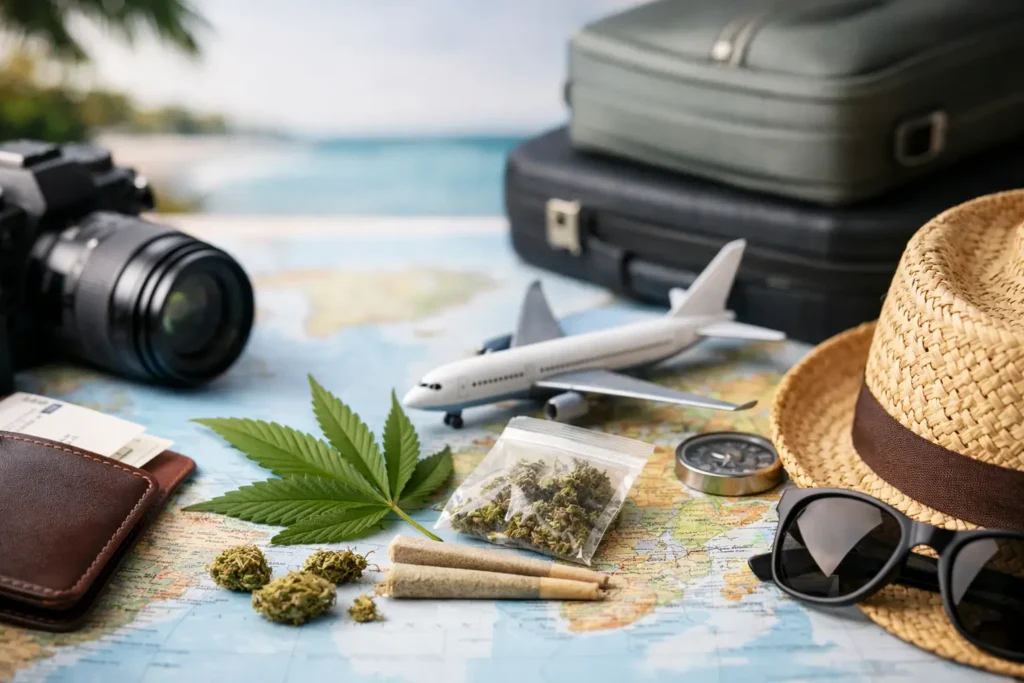
A great cannabis-friendly trip can go sideways before you leave the airport. Cannabis laws may look relaxed in a destination’s headlines, yet public use, buying options, hotel rules, and border enforcement can tell a very different story. The smart move is not to assume your home-state habits travel with you. Pack your bags, bring your curiosity, and do a little location-specific homework first.
For travelers, the question is rarely just, “Is weed legal?” The more useful question is, “What can I legally do in this exact city, as a visitor, and what local behavior will keep me out of trouble?” Those answers can change from country to country, state to state, and even neighborhood to neighborhood.
Why Cannabis Laws Are Hard to Read
Cannabis policy is not a simple legal-or-illegal switch. A place may have legalized adult possession but still prohibit public smoking. Another may have decriminalized small amounts, meaning penalties are reduced rather than eliminated. A third may permit medical cannabis only, with rules that do not recognize an out-of-state or foreign medical recommendation.
Then there is the gap between law and culture. Amsterdam is famous for coffeeshops, but that does not mean cannabis is permitted everywhere or that travelers can light up on any street. Barcelona’s private cannabis club scene operates very differently from a normal retail store. In many destinations, people may be discreetly tolerant of cannabis while police, hotels, and transport operators remain strictly opposed to it.
Treat broad online claims with caution. “Legal in Spain,” “legal in Thailand,” or “legal in the United States” is never enough for a travel plan. Look for the current rules on possession, purchase, consumption, cultivation, and transport. If a source cannot explain those details, it is not yet useful enough.
The Four Rules to Check Before You Travel
1. Possession and purchase
Find out whether adult-use cannabis is legal, medical-only, decriminalized, prohibited, or handled through a private-membership model. Check the legal age, which may be 18, 19, 21, or another threshold depending on the destination. Ask whether visitors can purchase legally, too. Some places limit access to residents, registered patients, or members of local associations.
Also check possession limits. A legal purchase does not give you permission to carry any amount you want. Limits can apply to what you may buy at once, carry in public, keep at a hotel, or possess at home. Concentrates and edibles sometimes fall under separate rules because their potency makes dosage and limits harder to compare with flower.
2. Where consumption is allowed
This is where many otherwise careful travelers get a legal weed hiccup. Legal possession rarely means legal public consumption. Streets, parks, beaches, sidewalks, restaurant patios, vehicles, hotel balconies, and outside transit stations are commonly restricted.
A licensed lounge, a private residence with permission, or a designated consumption venue may be the only acceptable option. Hotels are especially important: even where cannabis is legal, most properties can ban smoking and vaping anywhere on site. Breaking that rule can lead to cleaning fees, eviction, or a report to security.
Do not assume a strong smell, a busy nightlife district, or other people smoking makes a place lawful. Local enforcement can be uneven, but relying on uneven enforcement is not a travel strategy.
3. Transportation and borders
Never take cannabis across an international border. That includes flower, vapes, gummies, CBD products containing regulated cannabinoids, and leftovers from a legal purchase. The border is governed by its own rules, and the legal status at either end of the trip does not create an exception.
The same practical caution applies to airports, cruises, and many train routes. A domestic trip can still cross into a jurisdiction with different rules, and airlines may prohibit cannabis even when departure and arrival cities allow adult use. Driving after consuming is another major risk. Legal cannabis does not make impaired driving legal, and roadside testing standards vary widely.
Buy only what you can legally use before the end of your stay. Leaving an unopened package in your suitcase “just in case” is not worth the consequences.
4. Medical cannabis and prescriptions
A medical card from home is not an international cannabis passport. Countries generally control medical imports tightly, often requiring advance permission, original documentation, a limited supply, or a specific type of prescription. Some destinations do not allow visitors to bring cannabis medicines at all.
If you rely on cannabis for a medical reason, plan further ahead than a recreational traveler. Confirm the destination’s import process through official government or embassy information, ask your clinician about documentation, and have a legal backup plan if you cannot travel with your medication. Do not gamble on a casual email, an old forum post, or a label from a dispensary.
Legal Does Not Always Mean Easy Access
A destination can have cannabis reform on the books and still offer few straightforward options for a visitor. Retail stores may be sparse, clubs may require membership, and legal products may be available only to registered residents or patients. In other places, retail access is easy but consumption spaces are limited, forcing travelers to think carefully about accommodations.
This is why city-level information matters. A country’s policy creates the legal framework, but the day-to-day travel experience is shaped by local licensing, police priorities, housing rules, and tourism culture. A visitor in Las Vegas faces different practical choices than a visitor in Amsterdam, Prague, Bangkok, or Paris, even when each destination appears in the same “weed-friendly” search results.
The best cannabis travel plans build access and lodging together. If you cannot legally consume in your hotel, do not buy more than you can responsibly use at an approved venue. If the local system relies on private clubs, understand the membership process before arriving. If no clearly lawful option exists, accept that the destination may be better for sightseeing than smoking.
Respect Local Culture, Not Just the Written Rules
Cannabis etiquette is part of responsible travel. In some cities, cannabis culture is open, social, and woven into nightlife. In others, people keep it quiet despite relaxed possession rules. Religious sites, family areas, public beaches, historic districts, and crowded pedestrian zones are poor places to test local tolerance.
Keep your behavior low-key and considerate. Ask before consuming around other people. Avoid exposing workers, children, or strangers to smoke. Do not pressure travel companions who are not comfortable with cannabis, and do not treat a local community as a backdrop for a vacation story.
Buying from an unlicensed street source creates risks beyond the law. Product quality may be unknown, scams are common in tourist zones, and carrying cash to an unfamiliar meeting can create a safety issue. Where legal regulated access exists, it is usually the safer choice. Where it does not, the responsible answer may be to skip cannabis rather than chase a risky workaround.
How to Research Cannabis Laws Without Getting Misled
Start with current official information for the country, state, province, or city you are visiting. Then use a destination-specific guide to understand how those rules play out for travelers. Check publication dates, because cannabis policy can shift quickly after elections, court decisions, licensing changes, or government announcements.
Search for the details that affect your actual itinerary: visitor eligibility, possession limit, legal purchase locations, public-consumption restrictions, hotel policies, driving rules, and airport or border restrictions. If you are visiting multiple destinations, research each stop separately. A road trip can move through several legal systems in one afternoon.
It also helps to make a clear plan before you buy anything. Know where you will stay, how you will get around, whether you have a lawful place to consume, and when you will need to dispose of anything remaining. That small amount of planning preserves the freedom people want from cannabis travel without turning a vacation into paperwork, fines, or an uncomfortable conversation with local authorities.
The best travel memory is rarely about getting away with something. It is about enjoying a new place with confidence, respecting the people who live there, and leaving with nothing but good stories and a clean itinerary.