
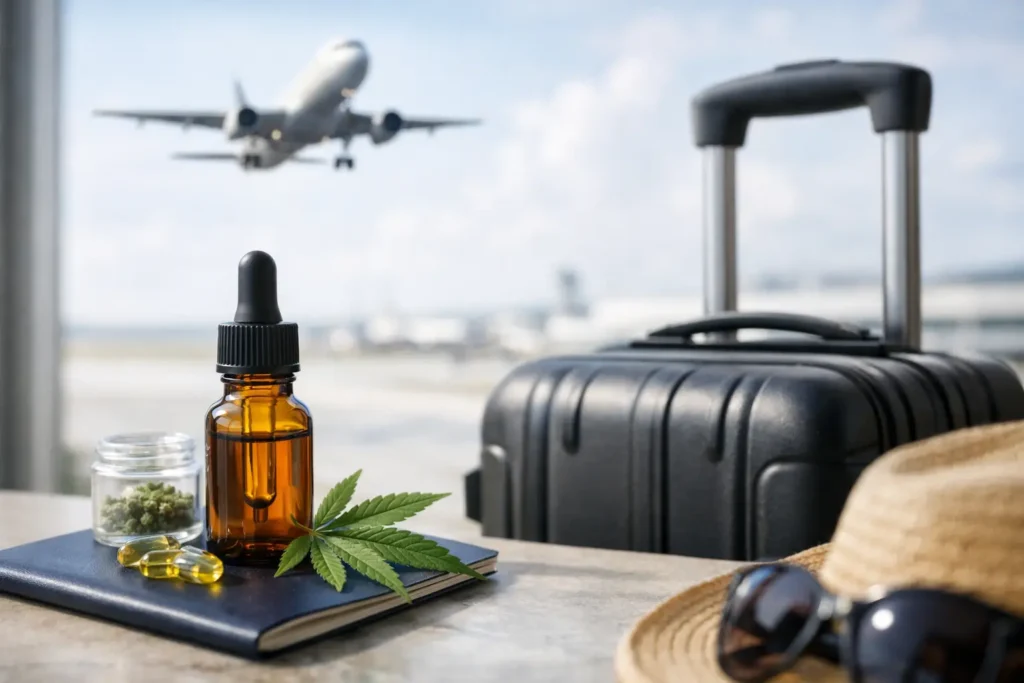
A CBD gummy that is legal in your home state can become a border problem the moment your plane leaves the ground. So, can you bring CBD internationally? Usually, the safest answer is no – unless you have confirmed that the exact product is legal to export, legal to import, and allowed in every country and transit airport on your itinerary.
CBD is often sold as a wellness product, but border officials do not judge it by the label on the front of the package. They look at what it contains, where you are entering, and whether local drug laws make an exception for it. For cannabis travelers, that distinction can save a vacation from an avoidable legal weed hiccup.
Why international CBD travel is so complicated
CBD laws are not one global rule with different packaging. One country may permit hemp-derived CBD with tightly limited THC. Another may allow CBD only with a prescription, pharmacy documentation, or government approval. A third may treat CBD extracts, oils, vapes, edibles, and cannabis-derived products as controlled substances regardless of their advertised THC level.
The problem is that CBD products vary widely. Full-spectrum products can contain THC, even when the amount is small. Broad-spectrum products are intended to remove THC, but labels and lab results are not a guarantee that a border officer will accept them. CBD isolate may appear simpler, yet it can still be restricted because of its source, format, or local rules on cannabinoid extracts.
A product that says “legal hemp” in the United States does not automatically meet another country’s definition of hemp. Nor does a US certificate of analysis create a right to carry the product through customs. Border rules are based on the destination’s law, not the rules where you bought it.
Can you bring CBD internationally if it has no THC?
Not automatically. THC-free or zero-THC labeling may lower the risk of carrying a product that tests positive for THC, but it does not settle the import question. Some destinations regulate CBD itself. Others only permit specific medical products. Some regulate oils and extracts more strictly than hemp foods, cosmetics, or topical products.
The format matters, too. A CBD face cream may be treated differently from a bottle of tincture. Gummies, capsules, and drinks can raise questions because they are ingestible. Vape cartridges are particularly risky: they combine cannabis rules with airline restrictions on batteries and liquids, and many countries take a hard line on cannabis vaping products.
Do not assume a product is fine because it is sold at an airport, online, or in a health store. Retail availability does not tell you whether cross-border transport is allowed. It may only mean the product can be sold in that specific place under that specific set of rules.
Your itinerary matters as much as your destination
International travel is rarely just point A to point B. If you connect through another country, that country can matter even if you never plan to leave the airport. A missed connection, overnight delay, luggage issue, or request to clear immigration can put you under the transit country’s laws with CBD in your bag.
This is why travelers should check every jurisdiction involved: the departure country, each layover country, and the final destination. That includes separate rules for overseas territories and island destinations, which may not follow the same policy as the mainland country travelers associate them with.
Cruises deserve the same caution. A CBD item that seems acceptable when you board in one port can become a problem at the next port of call. Cruise lines may also prohibit cannabis-derived products under their own policies, even where local law is more relaxed.
Medical CBD requires more than a casual explanation
If you use CBD for a medical reason, bring the documentation required by the country you are visiting – if that country allows you to bring it at all. A doctor’s letter, prescription copy, original packaging, and a product ingredient list can be useful, but they do not override an import ban.
Some countries have formal procedures for travelers carrying controlled medication. They may require advance permission, a limited supply, notarized paperwork, or a prescription from a local doctor. Those systems are often designed around named pharmaceutical medicines, not wellness-market CBD oils or gummies.
That creates an uncomfortable but practical reality: a US physician’s recommendation may explain why you have CBD, but it may not make the product lawful abroad. If CBD is essential to your treatment plan, contact the destination’s embassy or consulate before booking your trip and ask about the exact product, ingredients, dosage, and permitted quantity. Get any approval in writing when possible.
What to check before packing CBD
Before CBD goes anywhere near your suitcase, verify the details that border authorities actually care about. Check the active ingredients and whether the product is hemp-derived, isolate, broad-spectrum, or full-spectrum. Confirm the THC amount in the product itself, not just the marketing claim. Then look at the destination’s import rules for CBD, cannabis extracts, and controlled medicines.
You should also check your airline’s conditions of carriage. Airlines can prohibit items even if they may be legal in a particular location. Keep in mind that placing CBD in checked luggage does not make it less visible to customs. Concealing, relabeling, or transferring a product into an unmarked container is a bad move. It can make a routine question look much more serious.
If the rules are unclear, conflicting, or hard to verify through official sources, treat that uncertainty as your answer. Leave the CBD at home. A few days without a nonessential product is usually a far better trade-off than confiscation, denied entry, fines, or criminal charges.
Common CBD travel mistakes to avoid
The most common mistake is relying on a domestic rule. US federal rules, state rules, and TSA guidance do not tell you what customs officers in another country will do. International borders are a different legal environment.
Another mistake is treating low THC as no THC. Full-spectrum CBD can contain enough THC to cause trouble under strict laws, and products are not always tested or labeled consistently. Travelers also get caught out by assuming a destination known for cannabis culture is automatically CBD-friendly. Tolerance, decriminalization, social clubs, medical access, and legal importation are all different things.
Finally, avoid taking advice from a years-old forum post, a retailer, or a friend who traveled before a law changed. Cannabis policy moves quickly, and enforcement can differ at the local level. Destination-specific research is worth the extra few minutes.
A smarter way to travel with CBD in mind
For most leisure travelers, the low-stress choice is to travel without CBD and research legal local options after arrival. That does not mean you should expect to find CBD everywhere, or assume that a local product is legal just because it is offered to tourists. It means you avoid carrying a cross-border product before you understand the local landscape.
If you do find legal CBD at your destination, buy from a reputable local seller and keep the product for use in that destination. Do not turn the return flight into another customs gamble. The same check applies when you travel home: your home country’s import laws and quantity limits still control what you can bring back.
Cannabis travel can be a great way to experience new places, from established scenes to quieter destinations with their own local customs. The best trips leave room for discovery without forcing you to explain an unfamiliar oil, gummy, or cartridge to a border officer. Pack light, know the rules for each stop, and let your destination guide the experience – not a product that never needed to cross the border.