
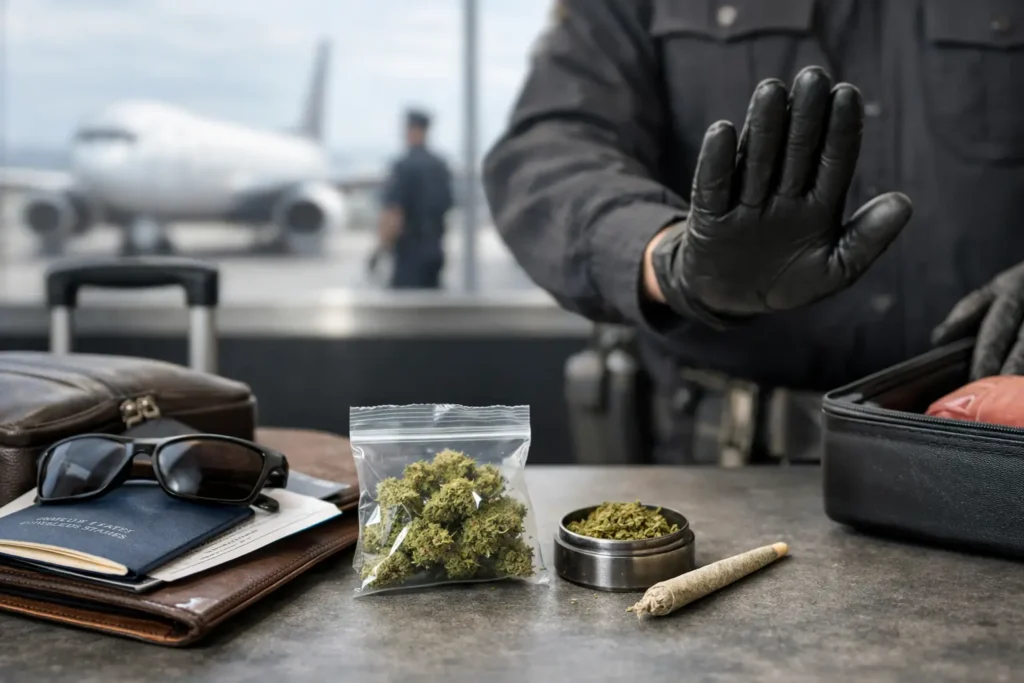
A legal dispensary purchase can become a serious travel problem the moment you cross the wrong line. To avoid cannabis border penalties, treat every border, airport, ferry terminal, and interstate checkpoint as a fresh legal jurisdiction – not as an extension of the place where you bought your weed legally.
That may sound cautious, but it is the rule that keeps a cannabis-friendly vacation from turning into an expensive, stressful legal weed hiccup. Cannabis laws can change between neighboring states, provinces, countries, islands, and even airports in the same metro area. Your job as a traveler is not to find a clever workaround. It is to enjoy the local scene where it is allowed, then leave it there.
Why Cannabis Borders Create Bigger Risks
Cannabis rules do not travel with you. A product may be legal for adult use in one state yet prohibited across the state line. It may be tolerated in a destination country but still illegal to bring through customs. A place with legal medical cannabis may not recognize a recommendation, patient card, or prescription from home.
International borders are especially high-stakes. In the United States, cannabis remains illegal under federal law, so taking it across an international border can lead to seizure, questioning, fines, arrest, or consequences for future travel. This applies whether you are driving into Canada, boarding a cruise, flying to Europe, or returning from a Caribbean trip.
The form of cannabis does not necessarily change the answer. Flower, pre-rolls, edibles, vape cartridges, concentrates, drinks, tinctures, and infused topicals can all create trouble. So can products marketed as CBD or hemp if they contain prohibited amounts of THC, are poorly labeled, or are treated differently at your destination.
How to Avoid Cannabis Border Penalties Before You Pack
The simplest travel strategy is also the safest: do not pack cannabis for a border crossing. Empty your luggage before you leave, including the small places travelers forget – jacket pockets, toiletry bags, backpacks, camera cases, medication organizers, and the center console of a car.
This matters even if you have no intention of bringing cannabis. A half-used vape, a forgotten gummy, or a few crumbs at the bottom of a bag can still trigger questions. Do a real pre-departure check rather than assuming a quick glance is enough.
Be just as careful with cannabis accessories. Clean grinders, pipes, rolling trays, and vape batteries can carry residue. In some locations, residue alone may be enough to cause delays or a seizure. If an item cannot be thoroughly cleaned and is not worth losing, leave it at home.
Do not rely on a medical card as a border pass. Medical cannabis programs are usually local or national systems with specific rules, and cross-border recognition is limited. A doctor’s recommendation may help explain why you use cannabis, but it does not override customs law or federal law.
Flying Is Not a Legal Shortcut
Airports can be confusing because local law, airport policy, airline policy, and federal authority can overlap. A departure airport may be in a legal state, while your flight route or arrival airport is not. Even on a domestic trip, carrying cannabis through airport security can expose you to consequences depending on where you are and how law enforcement responds.
Never assume that placing cannabis in checked luggage solves the issue. It does not. Checked bags are still your bags, and moving cannabis by air may create additional legal risk. The same principle applies to private flights, charter flights, and flights with a connection in another jurisdiction.
If you are flying internationally, the answer is far clearer: do not take cannabis with you. Plan to travel empty and research the destination’s local rules after you arrive.
Driving Requires a Route Check, Not Just a Destination Check
A road trip can cross multiple legal regimes in a single afternoon. Even if cannabis is legal at your starting point and final stop, the route may pass through a state, tribal nation, federal property, or border checkpoint with different enforcement rules.
Keep cannabis out of the car when crossing any border. Do not transport it for a friend, and do not let another passenger place it in your vehicle. If you are renting a car, inspect it before and after your trip. Previous renters can leave behind a vape, packaging, or loose cannabis, and you do not want to discover it during a police stop or at a border inspection.
Impaired driving is another separate risk. Legal possession never means legal driving after using cannabis. If you plan to consume, make a transportation plan first: walk where it is permitted, use public transit, call a rideshare, or designate a sober driver.
Know the Difference Between Local Access and Importing
A cannabis-friendly destination may offer regulated dispensaries, social clubs, private consumption spaces, or a culture of informal tolerance. None of that means visitors can bring their own supply into the country or take souvenirs home.
For example, a traveler may be able to purchase cannabis legally or semi-legally after arriving in a destination, depending on local eligibility rules and enforcement practices. But importing a vape cartridge in your luggage can still be illegal before your vacation begins. Likewise, buying a legal edible at a destination does not make it legal to carry through customs on the way home.
This distinction is central to responsible weed travel: access at the destination and transport across the border are two different legal questions. Check both before you make plans.
Local Weed Guide focuses on destination-specific information for this reason. Broad headlines about a country being “weed-friendly” rarely tell you enough. You need to know what applies in the city you are visiting, whether tourists can legally buy cannabis, where consumption is restricted, and whether local culture treats public use as normal, rude, or risky.
Be Honest at Customs, Without Trying to Talk Your Way Out of It
Border officials can ask direct questions about what you are carrying and where you have been. Never make a false declaration or lie to customs officials. Misrepresentation can create a more serious problem than the underlying item.
At the same time, do not volunteer unrelated details or speculate about what is in a bag. Answer questions truthfully and clearly. If you are detained, searched, charged, or concerned about your immigration status, ask to speak with a qualified lawyer as soon as possible. Rules about searches, questioning, devices, and legal representation vary by country and circumstance.
If an officer finds cannabis, do not argue based on laws from another state or country. Saying, “But it was legal where I bought it,” does not change the authority at the border. Stay calm, avoid confrontational behavior, and understand that the immediate priority is preventing the situation from escalating.
Watch for CBD, Delta-8, and “Hemp” Assumptions
Travelers often view CBD as harmless because it may be sold openly at home. That assumption can be costly. Some countries restrict CBD, require a prescription, ban cannabis extracts, or set THC limits that differ from U.S. standards. Labels can be inaccurate, and an officer may not accept a package’s marketing language as proof that a product is permitted.
Delta-8 THC and other hemp-derived intoxicants are even less predictable. Their legal status shifts quickly in the United States and abroad, while customs officials may simply treat them as cannabis products. Unless you have verified that a specific product is lawful to import, the low-risk decision is to leave it behind.
A Better Cannabis Travel Plan
The best cannabis travel plan is built around buying nothing until you understand the place you have arrived in – and consuming nothing you cannot responsibly leave behind. Research local possession limits, tourist purchase rules, consumption restrictions, driving laws, and the realities of enforcement. Check close to departure, because rules, policies, and enforcement priorities can change.
Then budget for a simple truth: any cannabis you buy at your destination may need to be used there legally or discarded before departure. It is not ideal if you are used to saving a favorite product, but it is far cheaper than a border delay, a fine, a missed flight, or an entry problem on a future trip.
Pack light, travel clear, and let the destination set the rules. The global cannabis scene is worth exploring, but the best souvenir is a great trip with no customs story attached to it.