
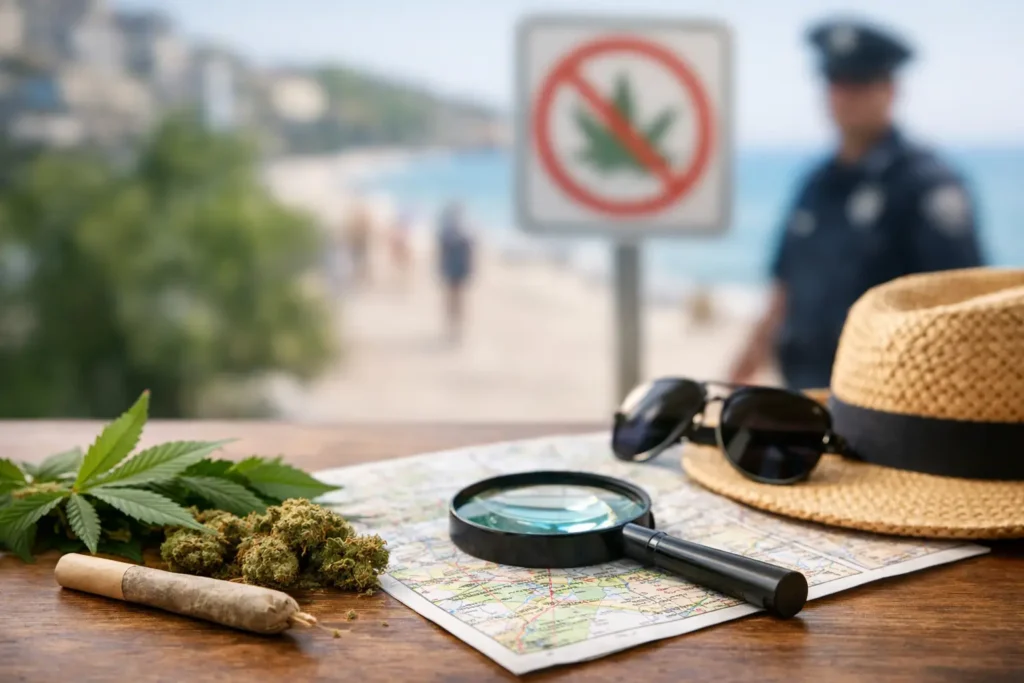
A sunny park bench, a hotel balcony, a quiet beach after dark – these can feel private when you are traveling. Legally, they often are not. If you are asking where is public cannabis prohibited, the short answer is: in far more places than first-time cannabis travelers expect.
Even in destinations with legal recreational cannabis, public consumption is usually the line authorities enforce most consistently. A city may allow adults to buy or possess cannabis while banning smoking, vaping, or consuming it in streets, parks, vehicles, beaches, and nearly every indoor public setting. Pack your bags and join the global cannabis scene, but leave assumptions at home.
Where Is Public Cannabis Prohibited? Start With “Public”
“Public” does not only mean standing on a busy sidewalk. In cannabis law, it can cover any place that is open to the public, visible to the public, shared with other people, or controlled by a business or government body. The exact definition changes by country, state, province, and city, which is why a legal weed destination can still produce avoidable legal weed hiccups.
The most common no-consumption zones are streets and sidewalks, public squares, parks, playgrounds, beaches, public transit, transit stations, parking lots, and inside vehicles. Schools, hospitals, government buildings, workplaces, airports, and hotel common areas are also regularly off-limits.
Private property is not an automatic green light, either. A rental apartment, hostel room, hotel balcony, cruise-ship cabin, or vacation home may be privately occupied but still subject to a no-smoking policy, lease rule, or local ordinance. The property owner can ban cannabis even where possession is legal.
Legal to Buy Does Not Mean Legal to Use Anywhere
This is the core travel rule: legalization usually regulates possession and sales separately from consumption. Cannabis-friendly destinations often create a tightly controlled system because smoke, odor, secondhand exposure, and neighborhood complaints are political flashpoints.
In many US legal states, public smoking or vaping remains prohibited. Bars, restaurants, sidewalks, parks, and hotel rooms generally do not become consumption spaces just because dispensaries are legal. Some cities permit licensed cannabis lounges, but those licenses are specific. Do not assume a dispensary has an on-site area, or that any lounge allows tobacco, food, alcohol, or vaping.
Canada follows a similar pattern. Cannabis is legal for adults at the federal level, but provinces, municipalities, landlords, and businesses can impose additional restrictions. A visitor may find that a city treats cannabis smoke much like tobacco smoke, with extra buffer zones around entrances, schools, and playgrounds.
Elsewhere, the gap can be even wider. In the Netherlands, coffeeshops are known for cannabis culture, but public use is not universally tolerated and local rules can be strict in busy central areas. Spain’s private social club model does not turn streets, plazas, beaches, or tourist nightlife districts into legal smoking zones. Thailand’s rules have changed rapidly in recent years, making current local guidance especially essential. A place with visible cannabis shops is not necessarily a place where outdoor consumption is allowed.
The Places Travelers Misread Most Often
Hotel balconies and windows
A balcony may feel like your own outdoor corner, but smoke can travel directly into another guest’s room. Hotels commonly treat balconies as part of the property’s smoke-free premises. A complaint from a neighbor can mean a cleaning fee, removal from the property, or involvement from security. Ask the hotel before consuming, and accept that “no smoking” often includes cannabis and vapes.
Beaches, parks, and scenic viewpoints
Travelers often choose open-air spaces because they seem low impact. These are also highly visible areas where local police, park staff, families, and other visitors are present. Beaches and parks may have their own bylaws, including smoking bans that apply to cannabis. A spectacular viewpoint is worth keeping memorable for the right reasons.
Cars, scooters, and rental vehicles
Never consume cannabis in or around a vehicle if you plan to drive. In many places, cannabis use in a vehicle is prohibited even when parked. More importantly, impaired driving laws are serious, roadside testing practices vary, and rental companies can charge heavily for odors or damage. Put the keys away and use legal transportation later if you choose to consume.
Airports and border crossings
Airports are among the worst places to test the limits. Federal, national, and aviation rules may apply regardless of what the city outside permits. Cannabis should never cross an international border, including between two places where it is legal. That includes cannabis flower, edibles, oils, vapes, and products containing THC. Dispose of or consume legally before reaching the airport only if local law and the venue rules allow it – never carry it through security or customs.
How to Find a Legal Place to Consume
The safest answer is usually a genuinely private residence where the owner allows it, or a specifically licensed cannabis consumption venue. That may sound limiting, but it is better than treating discretion as legality.
Before you buy anything, check three layers of rules: the country or state law, the city ordinance, and the policy of the property where you are staying. Local regulations can be more restrictive than broader legalization laws. A licensed retailer, hotel concierge, or host may be able to explain their own policy, but do not pressure staff to suggest illegal workarounds.
Look for clear language such as “licensed consumption lounge,” “on-site consumption permitted,” or “designated smoking area.” Even then, confirm what form of cannabis is allowed. Some venues permit vaping but not smoking. Others may allow flower only in a ventilated area, limit edible consumption, require an age check, or prohibit bringing in products purchased elsewhere.
If you cannot find a clearly legal, permitted setting, the responsible move is to wait. Cannabis travel is more enjoyable when you are not watching for security guards, trying to hide a smell, or worrying about a fine.
Public Cannabis Rules and Local Etiquette
Law is the minimum standard. Etiquette determines whether travelers help or harm the local scene.
Avoid consuming near children, families, outdoor dining, religious sites, apartment entrances, and crowded nightlife queues, even if enforcement seems relaxed. Do not assume that a local person’s behavior is a reliable legal guide. Residents may know informal norms, may be taking a risk, or may have a very different relationship with local law enforcement than a visitor does.
Odor matters, too. Cannabis smell can trigger complaints in shared buildings, taxis, rideshares, and rentals. Edibles may be less noticeable than smoking, but they are not a loophole: public consumption laws can cover all cannabis products, and edibles can take longer to affect you than expected. Start low, wait patiently, and keep packaging away from children and pets.
Respect for local culture matters as much as reading a statute. In some destinations, cannabis is decriminalized but socially frowned upon. In others, enforcement can change by neighborhood, event, or police priority. Tourists rarely benefit from arguing technicalities on the street.
What Happens If You Consume in Public?
The outcome depends on the destination and the circumstances. In a regulated US or Canadian market, a public-use violation may result in a warning, citation, fine, confiscation, or removal from a park or venue. In places with stricter cannabis laws, consequences can be far more serious, particularly for foreigners.
Your risk also rises when public use overlaps with other issues: driving, disorderly behavior, carrying more than the legal amount, consuming near a school, violating a hotel policy, or crossing a border. Being discreet does not erase those risks. It can also make it harder to ask for help if something goes wrong.
A smart traveler keeps identification handy, stays calm during any interaction with authorities, and does not offer extra information. But the best strategy is simpler: know the rule before you consume, and choose a place where permission is clear.
The best cannabis travel stories come from great food, interesting neighborhoods, and new connections – not from a citation outside your hotel. When the rules are unclear, save the session for a setting that is plainly legal and respectful.