
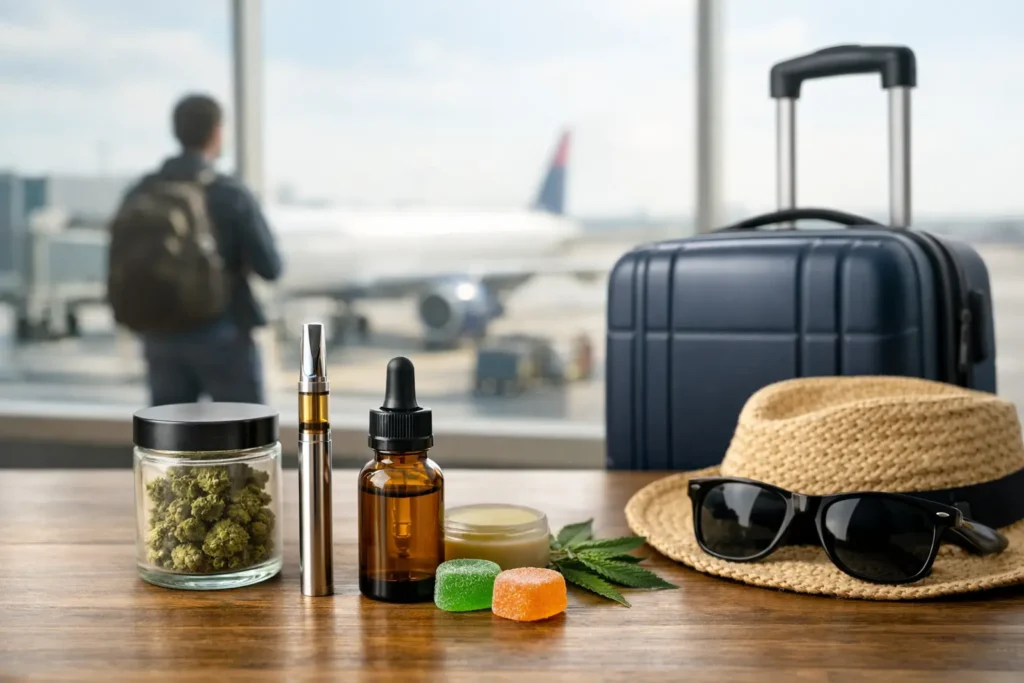
A dispensary menu can make a destination look easy: flower, gummies, vapes, oils, pre-rolls, and CBD drinks all sitting side by side. But what cannabis products are legal is not answered by the menu alone. The real answer changes by country, state, city, your age, whether you are a resident or patient, and even the exact place where you plan to consume.
For cannabis travelers, the safest rule is simple: legal possession does not automatically mean legal purchase, public use, transport, or border crossing. Pack your bags and join the local scene, but do it with a clear read on the rules before a small vacation purchase turns into a legal weed hiccup.
What cannabis products are legal depends on the legal model
Cannabis laws usually fall into a few broad models, but the details inside each one matter far more than the label. A place described as “legal” may allow adult-use sales. Another may allow only medical patients to buy cannabis. A third may have decriminalized personal possession while still banning retail sales. And some destinations tolerate cannabis in certain private clubs or social spaces without creating a fully legal commercial market.
In an adult-use market, adults over the local age limit can generally buy regulated cannabis from licensed retailers. That can include THC flower, concentrates, vape cartridges, edibles, tinctures, capsules, topicals, and pre-rolls. Purchase limits, possession limits, package sizes, and potency caps still apply. In many U.S. states, for example, edibles are sold in carefully measured THC servings even when flower is widely available.
Medical-only markets work differently. A doctor’s recommendation, medical card, local registration, or qualifying condition may be required. Travelers often assume an out-of-state or foreign medical card will transfer automatically. Sometimes it does through a reciprocity program, but often it does not. Never rely on a medical authorization from home without checking the destination’s current rules.
Decriminalization is more limited than legalization. It may reduce penalties for carrying a small amount, but it does not necessarily make cannabis a legal product to buy, grow, share, or consume. A traveler can still face confiscation, a fine, or trouble with police if they purchase from an unlicensed source.
The products you are most likely to encounter
The categories below sound familiar, but legal treatment can vary sharply between them.
THC flower and pre-rolls
Dried cannabis flower is usually the clearest product in a regulated adult-use or medical market. It is also the form most likely to be covered by simple possession limits. Pre-rolls are generally treated like flower, although infused pre-rolls may be classified differently because they contain added concentrate.
Even where flower is legal, smoking can be restricted. Hotels, rental apartments, beaches, parks, sidewalks, cars, and restaurant patios are commonly off-limits. A cannabis-friendly destination does not mean every public place is a smoking area. Ask about designated consumption lounges or private-use rules instead of assuming an outdoor space is fine.
Edibles, beverages, and tinctures
Edibles are legal in many regulated markets, but they come with their own rules. Authorities often cap THC per package or per serving, require child-resistant packaging, and ban packaging that resembles popular candy. Cannabis beverages and low-dose gummies can feel especially travel-friendly because they are discreet, but their effect is slower and longer-lasting than inhaled cannabis.
For first-time visitors, low and slow is more than a slogan. Wait before taking more, avoid mixing THC with heavy drinking, and keep products locked away from children. In countries with strict drug laws, a gummy is still cannabis even if it looks like ordinary candy.
Vapes, concentrates, and extracts
Vape cartridges, wax, shatter, hash, rosin, and other concentrates can be legal in licensed markets. They may also face tougher restrictions because of their high THC content. Some jurisdictions allow flower but restrict extracts; others allow regulated extracts but prohibit particular additives or flavored vape products.
Travel adds another complication: batteries and cartridges. Airline safety rules often require lithium batteries in carry-on luggage, but cannabis law can still prohibit taking a THC cartridge into an airport or across a state, national, or international border. Transportation rules do not make the product legal to carry.
CBD, hemp, and hemp-derived THC
CBD is not a universal travel pass. Many travelers see “hemp-derived” and assume a product is legal everywhere, but local laws may regulate CBD extracts, food products, novel cannabinoids, and THC content differently. A CBD oil that is permitted in one place may be restricted in another, especially if it contains detectable THC.
Hemp-derived delta-8 THC, delta-10 THC, THC-O, HHC, and similar products are even more complicated. Their status can shift quickly as lawmakers and health agencies respond to new products. Some U.S. states restrict or ban them despite federal hemp rules, while other places treat them as controlled intoxicants. If a label is vague about cannabinoids, potency, or testing, leave it behind.
Medical formulations and prescription cannabis
Certain destinations permit cannabis-based medicines but not recreational cannabis. These may include pharmacy products, prescription oils, capsules, sprays, or carefully controlled preparations. That does not mean a traveler can bring their own cannabis medication across the border. International rules are particularly strict, and documentation may not protect you from import laws.
Legal to buy is different from legal to carry
This is the distinction that catches travelers most often. In the United States, a product can be legal under a state’s adult-use law and still create risk if it crosses state lines, because cannabis remains illegal under federal law. That includes driving a sealed package from one legal state to another, mailing products, or taking them through an airport for a trip outside the state.
Crossing an international border is riskier still. Do not bring cannabis, cannabis edibles, THC vapes, or uncertain CBD products into another country unless you have confirmed the destination’s import rules and any required permits. “I bought it legally” is rarely a defense at customs.
The same caution applies to cruise ships, ferries, trains, and tours. The operator’s policy can be stricter than the local law. A port city may have dispensaries, while the ship itself maintains a zero-tolerance policy.
How to tell whether a product is actually legal where you are
Start with the destination, not the product. Check whether the country, state, province, or city allows adult-use cannabis, medical cannabis, possession only, or no cannabis at all. Then confirm the local minimum age, purchase limits, consumption rules, and whether visitors can buy.
When buying in a legal market, use licensed dispensaries, pharmacies, or officially permitted shops. Legal products normally come in labeled packaging with THC or CBD content, serving information, safety warnings, batch details, and required tax information. That is not just bureaucracy. It gives you a better idea of what you are consuming and reduces the chance of buying an untested product.
Be cautious with street offers, tourist-zone “weed stores,” and shops selling mystery gummies. In some cities, businesses openly market cannabis products despite operating in a gray area or outside the rules. A bright sign and a countertop display do not prove that a sale is legal. If staff cannot explain what is in the product, where it may be used, or what identification is required, walk away.
Local culture matters, too. Amsterdam, Barcelona, Las Vegas, Bangkok, and dozens of other destinations all have very different cannabis realities beneath the headlines. A city may be relaxed about private use while taking public smoking seriously. Another may permit sales but expect discretion. Respecting those norms keeps the experience better for residents and fellow travelers.
Travel smarter with cannabis
Keep cannabis in its original package, carry only what local possession rules allow, and consume only where it is permitted. Do not drive, cycle, or operate a scooter after using THC. Avoid bringing products into hotels or rentals without checking property policies, and never leave edibles where someone else could mistake them for snacks.
Laws and enforcement priorities can change quickly, so treat broad travel advice as a starting point rather than a final answer. Check current official rules close to departure, then let the destination guide your choices. The best cannabis travel story is the one that stays relaxed, respectful, and entirely free of avoidable legal surprises.