
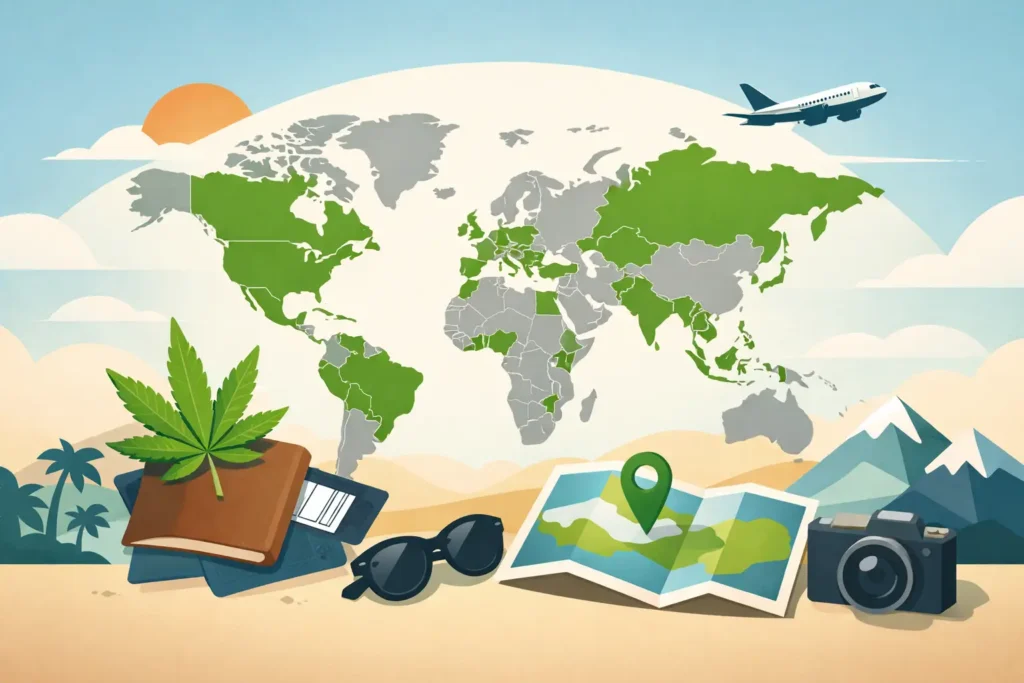
A great cannabis trip can go sideways before you even leave the airport. The answer to where is weed legal is rarely a simple yes or no: a place may allow possession but not sales, tolerate cannabis in certain venues but ban public smoking, or welcome locals while giving visitors few legal ways to buy.
For travelers, the useful question is not just whether cannabis is legal. It is whether you can legally access it, where you can consume it, and what happens if you get the rules wrong. Pack your bags with the right expectations, and you can avoid the legal weed hiccups that turn a relaxed trip into an expensive problem.
Where is weed legal for travelers?
Cannabis laws fall into a few very different buckets. Full adult-use legalization is the clearest setup: adults can generally buy and possess cannabis through regulated businesses, subject to age limits, purchase limits, and local rules. Canada and a growing number of US states fit this model, although the details change by province, state, and city.
Then there are destinations where possession or home growing is legal, but commercial sales are not broadly available. Germany, Luxembourg, Malta, and South Africa each have frameworks that can sound weed-friendly in headlines while offering limited options for a short-term visitor. In these places, being allowed to possess cannabis does not automatically mean there is a legal shop around the corner.
A third category is decriminalization or tolerated use. This lowers the risk of criminal penalties for small amounts, but it is not the same as a legal market. Amsterdam is the classic example. Coffee shops can sell cannabis under a long-standing tolerance policy, yet Dutch law is more complicated than the souvenir-shop version of the city suggests. Spain’s private cannabis-club scene is another often-misunderstood example: rules vary by region, clubs are not public dispensaries, and tourist access is never something to assume.
Finally, some countries permit medical cannabis only. A local prescription, registration process, or tightly controlled import permit may be required. A medical card from home usually does not travel well, and carrying cannabis across an international border without explicit authorization is a bad bet.
The easiest places for a legal cannabis trip
For straightforward access, Canada remains one of the most traveler-friendly choices. Adults can legally purchase cannabis from licensed retailers in most provinces, though the legal age differs by province and public consumption rules can be strict. In cities such as Toronto, Vancouver, Montreal, and Calgary, finding a store is easy. Finding a legal place to smoke may be harder. Hotels, sidewalks, parks, beaches, and building entrances can all have their own restrictions.
In the United States, adult-use cannabis is legal in many states, including popular travel destinations such as California, Colorado, Nevada, Illinois, Massachusetts, Michigan, New York, New Jersey, Oregon, and Washington. Las Vegas is a particularly useful lesson in why travelers need local details. Recreational stores are plentiful, but using cannabis in a casino, hotel room, rental car, or out on the Strip can still be prohibited. Licensed consumption lounges may be the practical answer when they are available.
US travel has an extra complication: cannabis remains illegal under federal law. That means you should not take it across state lines, even between two legal states. Do not bring it into airports, onto flights, or onto federal land. Buy locally, use it legally where allowed, and leave it behind before moving on.
Weed-friendly does not always mean easy to buy
Europe offers some memorable cannabis destinations, but it rewards travelers who read beyond the headline. In the Netherlands, adults can purchase small amounts from coffee shops that follow local rules. Public use is often restricted, especially in busy central areas, and some municipalities have tighter policies than others. Amsterdam may feel relaxed, but it is still a city with enforcement zones and neighbor-friendly expectations.
Germany’s modern cannabis rules allow adult possession and limited home cultivation, with cultivation associations designed to provide access for members. That does not create a Dutch-style retail market for someone arriving for a long weekend. Visitors should be especially careful about assuming a social club is open for walk-in purchases.
Malta allows adults to possess limited amounts and access cannabis through nonprofit associations, but the system is membership-based and not built like a tourist dispensary network. Luxembourg allows limited personal cultivation and possession, while public consumption remains restricted. These destinations may be legally progressive, yet they are not necessarily convenient cannabis-shopping stops.
Spain is often called legal, but that shortcut causes trouble. Private consumption and club models exist in a legally gray, regionally varied environment. Smoking on the street, buying from strangers, or treating a club like a bar can put you on the wrong side of local rules. Barcelona has an established club culture, but discretion and respect matter more than hype.
Places with fast-moving or confusing rules
Some of the most searched cannabis destinations are also the least stable. Thailand drew global attention after cannabis restrictions loosened, but the country’s rules, permitted uses, enforcement priorities, and retail landscape have been subject to frequent policy changes. Do not rely on an old viral video, a backpacker forum post, or a shop sign. Check current local rules immediately before your trip and again once you arrive.
Mexico is another destination where the legal reality is more complicated than the reputation. Court decisions and personal-use protections have changed the conversation, but a fully reliable nationwide retail system for adult travelers has not materialized in the way visitors might expect. Buying from an unlicensed street seller is not a clever workaround. It can create legal and personal-safety risks fast.
Across the Caribbean and Latin America, several countries have decriminalized personal possession, recognized personal cultivation, or created limited medical programs. Uruguay has a regulated adult-use system, but legal access is strongly tied to residency. Jamaica has religious, medical, and decriminalization provisions, but visitors should not confuse cultural familiarity with unrestricted legality. The same principle applies across the region: local tolerance is not permission to buy, carry, or consume anywhere you want.
Four rules that protect your trip
When you land in a cannabis-friendly place, keep your plans simple:
- Buy only through a clearly legal local channel. A licensed store, recognized coffee shop, or legitimate local program is far safer than a street offer.
- Treat public consumption as restricted unless a rule clearly says otherwise. Balconies, beaches, hotel rooms, parks, and cars are common trouble spots.
- Never cross a border with cannabis. This includes international borders, cruise ports, airports, and US state lines.
- Keep your ID handy, stay within possession limits, and do not drive after using cannabis. A legal purchase does not protect you from DUI laws.
These are not just formalities. Most traveler problems come from the gap between legal possession and illegal behavior in the wrong setting. A small amount in a sealed package may be fine; that same package in a rental car or airport security line may not be.
How to read a destination’s cannabis rules
Before booking, look for answers to five practical questions: What is the legal age? Can nonresidents buy? Where can cannabis be used? What possession limit applies? Is the product you want actually sold through a lawful channel?
Also separate national law from local law. A country may permit cannabis in principle while a city bans use in tourist districts, a region limits stores, or a hotel adopts a no-smoking policy. Your lodging rules matter just as much as the city’s reputation. Ask ahead rather than trying to hide smoke in a room, hallway, or balcony.
Cannabis etiquette travels well. Keep it low-key, do not pressure anyone to join, avoid smoking near families or crowded public spaces, and remember that locals live in the places you came to enjoy. The best cannabis travel stories usually start with good planning and end with you leaving no mess, no drama, and no legal surprises behind.
You may want to be careful when scoring points and choosing places to smoke. I recommend smoking in your room or in any quiet park. I met this dude and he introduced me to some nice buddies ( miketeefey@gmail.com ). I will definitely recommend him to stoners to get quality weed from him.