
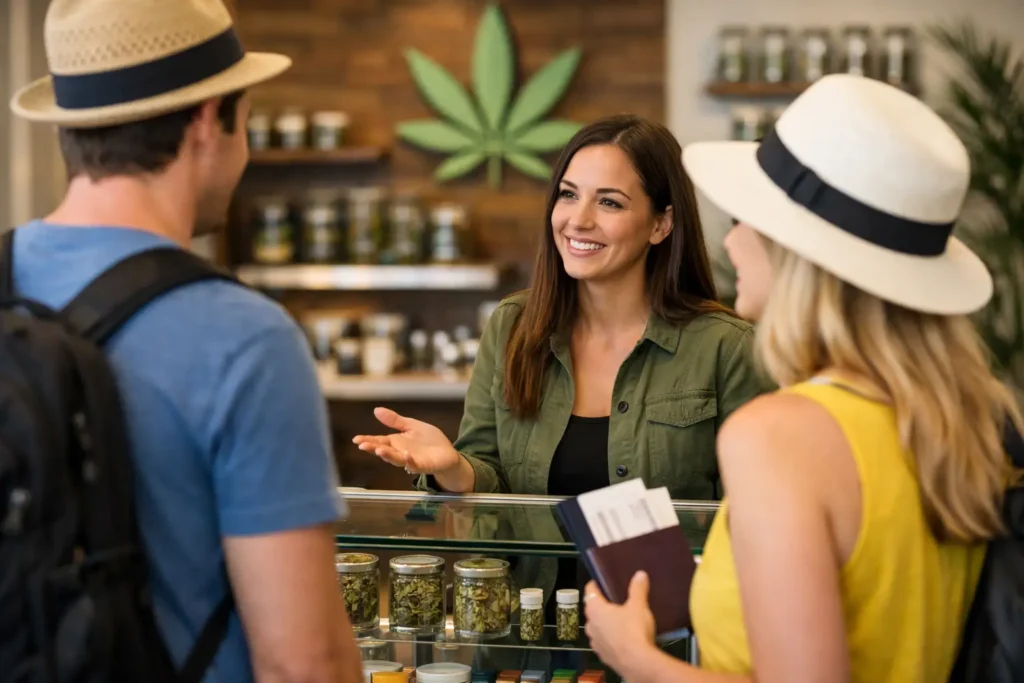
A glowing green cross outside a shop can make the answer look obvious. It rarely is. Can tourists visit dispensaries legally? In many legal cannabis destinations, yes, but walking through the door, making a purchase, carrying cannabis, and using it are four separate legal questions. Get one of them wrong and an easygoing vacation can turn into a legal weed hiccup.
The smart cannabis traveler does not rely on what was legal at their last stop. Rules change by country, state, city, neighborhood, and sometimes even the type of shop. Pack your bags and join the local scene, but start with the rules where your feet are actually landing.
Can Tourists Visit Dispensaries Legally? It Depends
In a place with adult-use cannabis sales, tourists can often enter a licensed dispensary and buy cannabis if they meet the local age requirement and show acceptable government-issued photo identification. In much of the United States, that means age 21 or older. A valid passport is commonly accepted for international visitors, though a dispensary can set its own ID policy and may refuse expired, damaged, or unclear documents.
That is the easy version. Some destinations legalize cannabis only for residents, registered medical patients, or members of private associations. Others decriminalize possession without allowing legal retail sales. You may see cannabis culture everywhere and still have no lawful place to buy.
Also, a tourist’s immigration status can create additional risk in the United States. Cannabis remains illegal under federal law, even where a state permits adult use. Non-US citizens should be especially cautious: cannabis use, possession, or even admissions about prior use can have immigration consequences that are far more serious than a routine state-level citation. If your ability to enter, remain in, or return to the US matters, get qualified legal advice rather than treating a recreational cannabis law as a complete green light.
Visiting, Buying, Using, and Traveling With Cannabis
A dispensary may legally sell to you, yet the most convenient-looking next step may still be prohibited. Public consumption is illegal in most cannabis destinations. That includes sidewalks, parks, beaches, restaurant patios, parked cars, and hotel balconies unless a local rule expressly allows it. The smell alone can attract unwanted attention, especially in a city that welcomes cannabis businesses but protects public spaces aggressively.
Hotels and vacation rentals can ban cannabis on their private property, even in a legal state or country. Smoking restrictions, fire codes, and building rules often apply to vapes and cannabis smoke alike. Do not assume a private room means a private consumption space. Ask before booking if legal on-site consumption is a priority.
Transportation is where travelers make the costliest mistake. Never take cannabis across an international border. Do not carry it between US states, either, even if both states have legal adult-use markets. Crossing state lines puts you under federal jurisdiction. Airports are especially poor places to test the gray areas: airport property, airline rules, and federal law can all come into play.
The practical rule is simple: buy locally, consume only where allowed, and finish or legally dispose of what you have before you leave that jurisdiction. A souvenir edible is not worth a border problem.
How Tourist Access Changes by Destination
US recreational states
States such as Nevada, California, Colorado, Massachusetts, Illinois, and Michigan have licensed adult-use dispensaries where eligible visitors can generally purchase cannabis. Still, city and county rules can differ. Las Vegas has dispensaries, for example, but using cannabis on the Strip, in casinos, or on the sidewalk is not automatically legal. Some destinations also have licensed consumption lounges, which can be a much better option than guessing whether your hotel room is acceptable.
Purchase limits apply, and a dispensary will track the amount sold during a transaction. Do not try to work around limits by visiting several stores. Possession limits, rules on concentrates, and home cultivation laws vary widely. Medical-only states are a different category: an out-of-state medical card may not be recognized, and international visitors generally should not expect access.
Canada
Canada permits adult recreational cannabis nationwide, but provinces and territories control age limits, retail systems, and some possession rules. Visitors who meet the local age requirement can generally buy from authorized retailers with ID. The minimum age is 18 in Alberta, 19 in many provinces, and 21 in Quebec.
Cannabis cannot cross the Canadian border in either direction, including between Canada and US states where cannabis is legal. Keep products in their original packaging, follow local rules on where you can consume, and do not bring anything into an airport for a flight abroad.
Europe is not one dispensary model
Europe rewards travelers who pay attention to labels. Amsterdam’s famous coffeeshops are not the same thing as US-style dispensaries. They operate under Dutch tolerance policies, and local municipal rules matter. A visitor may be able to buy and use cannabis under coffeeshop rules, but that does not mean cannabis is broadly legal throughout the Netherlands or safe to carry beyond it.
Barcelona’s cannabis social clubs are private member associations, not casual retail stores. Membership processes, age rules, club policies, and local enforcement can change. Street sellers and offers to “skip the membership” are a reliable way to invite trouble.
Germany offers another important distinction. Adult possession has been legalized within limits, but tourist-friendly commercial dispensaries are not the standard model. Cultivation associations have residency-related requirements, so visitors should not assume that legalization equals retail access. Across Europe, legal possession, tolerated use, private clubs, and licensed sales are very different categories.
Fast-changing markets need extra caution
Countries that have recently reformed cannabis laws can be the hardest places to read from old travel posts. Thailand is a prime example: its cannabis framework has shifted quickly, and rules around sales, medical purposes, public use, and regulated products may change with little warning. A storefront does not guarantee that every product, purchase, or use case is legal for a visitor.
When the law is moving, verify current government guidance and ask licensed businesses direct questions. If staff cannot clearly explain the rule, do not make them your legal adviser.
What to Check Before You Enter a Dispensary
Start with the destination’s legal category: adult-use retail, medical-only access, private-club access, decriminalization, or prohibition. Then check the local minimum age, whether your passport is accepted, the amount you may buy and possess, and whether there is a legal place to consume.
Ask the dispensary staff practical questions before paying: Is this product legal for a visitor to buy? What is the possession limit? Is there a licensed consumption area nearby? They can usually explain store policy and local basics, though they cannot give personal legal advice.
Keep your ID with you and keep purchases sealed until you reach a permitted private setting. Avoid driving after consuming, even if you feel fine. Cannabis impairment laws apply to tourists just as they do to locals, and roadside enforcement is not the travel memory anyone wants.
Cannabis Etiquette Still Matters
Legal access does not erase local culture. Be discreet where discretion is expected, never pressure travel companions, and do not assume everyone around you is comfortable with cannabis. In a busy tourist district, public smoking can frustrate residents and make enforcement more likely, even where personal possession is tolerated.
Buy only from legitimate, licensed businesses when regulated retail exists. Unlicensed products can be mislabeled, contaminated, unexpectedly potent, or tied to avoidable police attention. Start low with unfamiliar edibles, especially after a long flight, because dosage rules and product strengths are not identical from one market to the next.
If the answer to tourist access is unclear, treat that uncertainty as your answer for the day. There will always be another destination, another legal shop, and another chance to enjoy the local cannabis scene without putting the rest of your trip at risk.