
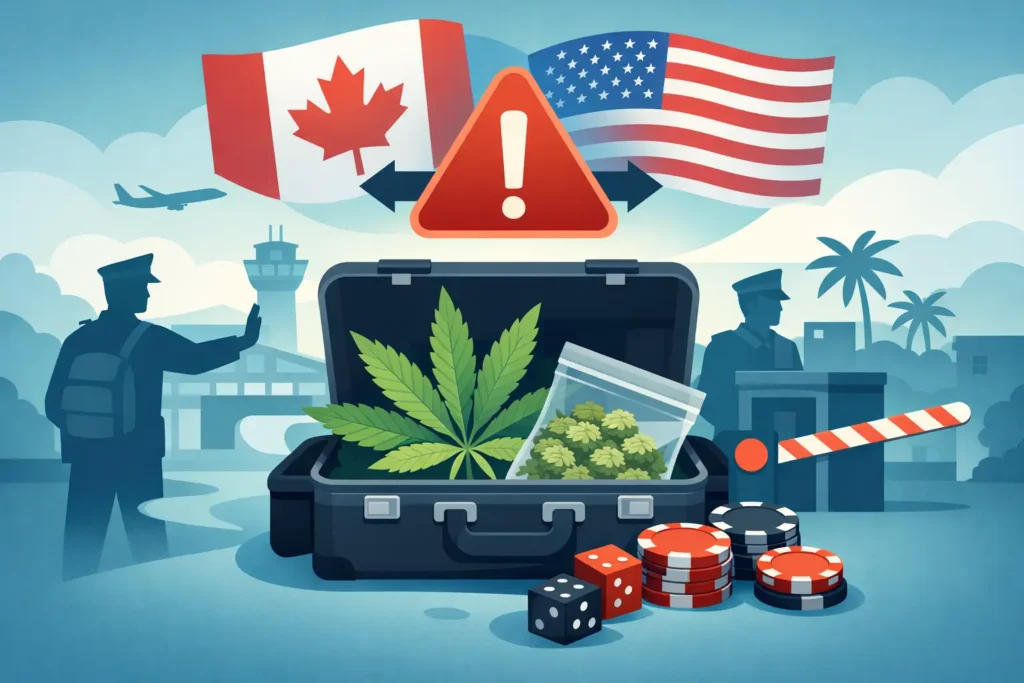
That pre-flight pocket check matters more than most travelers think. Bringing cannabis across borders – whether it is a joint, gummies, a vape cartridge, CBD oil, or a few grams left in a toiletry bag – can turn an otherwise easy trip into a serious legal problem. A product may be legal where you bought it and legal where you are headed, yet still be illegal to carry between the two.
For cannabis travelers, the simplest rule is also the safest: buy locally where it is legal, consume only where permitted, and leave every cannabis product behind before crossing a border. It is less exciting than traveling with your favorite strain, but it keeps a weed-friendly vacation from becoming a legal weed hiccup.
Why bringing cannabis across borders changes the rules
Cannabis laws are usually written and enforced by jurisdiction. A city, state, province, or country may allow adult-use cannabis, medical cannabis, possession, or retail sales within its own boundaries. The moment you cross into another jurisdiction, a different set of laws applies.
International borders are the clearest example. Even between two countries with legal adult-use cannabis, customs rules can prohibit importing or exporting it without specific government authorization. Canada is a common source of confusion for US travelers. Cannabis can be legal for adults in Canada, and legal in several US states, but taking it across the US-Canada border remains illegal.
Domestic travel can be complicated, too. In the United States, cannabis remains illegal under federal law. State legalization does not create permission to transport marijuana across state lines. That applies even when both states allow recreational cannabis. Airports, interstate highways, federal land, and federal facilities can add another layer of risk.
The key distinction is this: legal possession at your destination does not automatically mean legal transportation to that destination. Treat the border itself as a hard stop, not a gray area to test.
Bringing cannabis across borders by plane, car, or train
Your mode of travel does not make the legal issue disappear. It only changes where you may encounter it.
Flying with cannabis
Airport security and airline travel create two separate concerns. Security screening is focused on safety threats, but officers can refer suspected illegal drugs to local law enforcement. Airlines also have their own rules, and international flights involve customs checks on arrival or departure.
Do not assume a medical card, a dispensary receipt, a sealed package, or a state-legal label makes cannabis acceptable in checked or carry-on baggage. In many places, it does not. Cannabis concentrates and vape cartridges can be especially risky because they may raise both drug-law issues and airline battery rules.
If you discover cannabis in your bag before entering security, do not carry it forward hoping nobody notices. Return it to a lawful location if possible, or use an official disposal option if the airport provides one. Never leave products in a random terminal bathroom, parking lot, rental car, or seat pocket for someone else to find.
Driving across a border
A road trip can feel casual, but border officers do not treat it that way. A bag of edibles in the glove compartment and a personal-use flower stash in the trunk are still cannabis products being transported across a border. Where cannabis is prohibited, the amount may affect the seriousness of a case, but “it was only a little” is not a reliable defense.
Rental cars add a practical headache. Many rental agreements prohibit illegal substances and smoking in the vehicle. Leaving odor, ash, packaging, or forgotten products behind can lead to cleaning fees or bigger problems. Keep your trip clean: do not use the car as storage, consumption space, or a place to hide anything.
Trains, ferries, and cruise ships
Travelers often overlook these routes. A ferry can cross into another country. A train may pass through a country where cannabis rules are stricter than the place you boarded. Cruise ships operate under their own policies and can visit ports with very different drug laws.
Before boarding, look at the full itinerary, including transit stops. Your final destination is not the only place that matters.
Medical cannabis is not a universal travel pass
Medical patients deserve clear information here. A prescription or medical cannabis card may allow possession in your home state or country, but it does not usually authorize international transport. Medical cannabis is tightly controlled in many countries, and some destinations do not recognize foreign recommendations, cards, or prescriptions at all.
There are limited situations in which a country permits visitors to bring prescribed controlled medication with advance documentation or approval. Requirements vary widely and can involve original packaging, a doctor’s letter, quantity limits, declarations, and prior permission. Cannabis is often treated more strictly than ordinary medication.
Do not rely on a blog post from two years ago, a friend’s experience, or a dispensary employee’s opinion for a medical travel decision. Check the official rules of every country on your route and, when the stakes are high, speak with a qualified legal or medical professional. If the destination does not clearly permit it, plan to travel without it.
Don’t forget CBD, hemp, and cannabis leftovers
“CBD” is not a magic word at a border. Some CBD products contain detectable THC, are inaccurately labeled, or are prohibited because of how local law defines cannabis extracts. A gummy, tincture, topical, or vape that seems harmless at home may still be treated as a controlled substance elsewhere.
Hemp rules also vary. One country may allow products with a small amount of THC while another may prohibit them outright. If a product looks, smells, or tests like cannabis, explaining that it is legal hemp can become a difficult conversation in the wrong jurisdiction.
The same goes for leftovers and residue. Empty containers, used vape pens, grinders, rolling papers with visible residue, and bags with flower fragments can create trouble or delays. Before travel day, clean out jackets, backpacks, toiletry kits, camera bags, and luggage compartments. This is not about hiding anything. It is about not accidentally transporting a controlled product you forgot was there.
A smarter cannabis travel plan
The best cannabis travel planning happens before you pack your bags. Instead of deciding what you can get away with, build a plan around what is legal and normal where you are going.
Use this quick pre-trip check:
- Confirm whether adult-use or medical cannabis is legal at your destination, not just in the country overall.
- Learn whether visitors can legally buy it, and whether retail sales are actually available.
- Check public-use rules, since legal purchase rarely means you can smoke anywhere.
- Review your complete route, including layovers, border crossings, ferry stops, and return travel.
- Empty all cannabis, CBD, and THC-related products from your luggage before you leave.
Once you arrive, local purchase is usually the lower-risk option where it is allowed. It also gives you a better feel for the local market. Amsterdam coffee shops, Barcelona social clubs, Las Vegas dispensaries, and Bangkok’s fast-changing cannabis scene do not operate under one universal rulebook. Some places welcome tourists openly; others have membership systems, strict consumption rules, limited access, or laws that are changing quickly.
That is where destination-specific research earns its place in your travel plans. Look beyond broad claims that a country is “weed-friendly.” Find out what applies in the exact city or region you are visiting, what ID is required, where consumption is allowed, and whether local culture is relaxed or discreet. Legal does not always mean socially welcome.
What to do if you are stopped
If authorities ask about cannabis, stay calm and respectful. Do not argue from another jurisdiction’s laws, make jokes, offer explanations that are not true, or attempt to get rid of products during an encounter. Follow lawful instructions and seek legal counsel if you are detained or facing charges.
A border is not the place for cannabis advocacy, clever packaging, or a debate about fairness. Officers are enforcing the law where you are standing, not the one you wish applied.
Traveling without your own stash may feel inconvenient, especially if cannabis is part of how you relax, sleep, or explore. But the freedom of arriving without that worry is worth more than a forgotten vape or a few vacation edibles. Plan for the destination, respect the border, and save the good part of cannabis travel for the places where you can enjoy it legally.